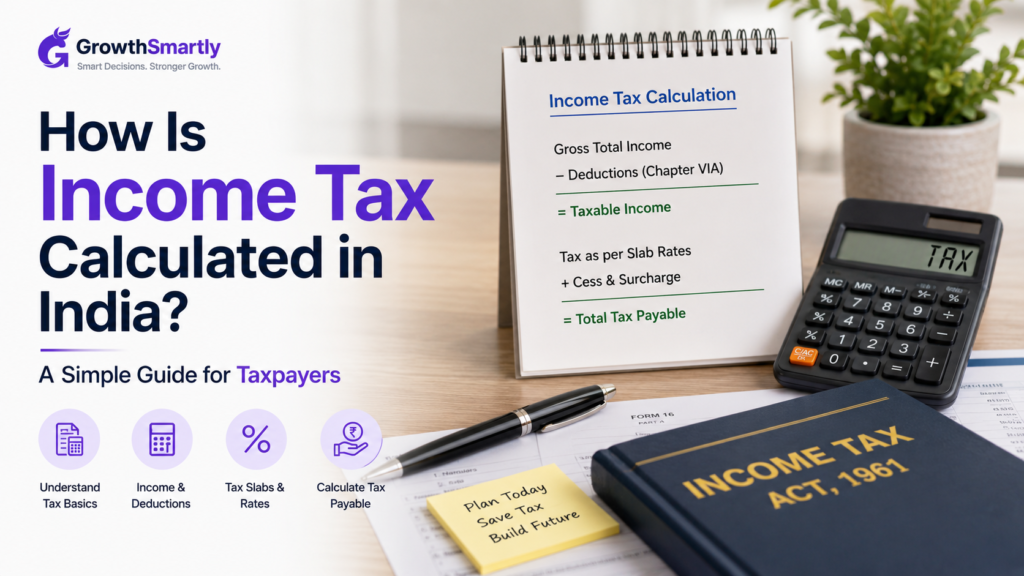
Every year around tax filing season, the same question pops up in group chats and office conversations: “Bhai, how much tax will I actually pay this year?” For something that affects nearly every earning Indian, income tax calculation remains oddly mysterious to a lot of people. Slabs, deductions, rebates, two different regimes: it can feel like a maze designed to confuse rather than inform.
This guide breaks the process into plain steps, so the next time someone asks how tax is calculated, you won’t just shrug and say “the CA handles it.”
Step 1: Figure Out Your Gross Total Income
Before any tax calculation begins, you need your total income from all sources for the financial year, including salary, house property income (like rent), capital gains from investments, business or professional income, and income from other sources such as interest on savings or fixed deposits. Add all of this together, and you get your gross total income, the starting point for everything that follows.
Step 2: Choose Between the Old and New Tax Regime
India runs two parallel tax systems, and you get to pick which works better each year. The new regime is the default option and offers lower rates but very few deductions. The old regime has higher rates but allows exemptions like HRA, Section 80C investments, and home loan interest.
Under the new regime for FY 2026-27, the government has kept the same structure as the previous year, with income up to ₹4 lakh taxed at nil, followed by progressive rates of 5%, 10%, 15%, 20%, and 25% across subsequent slabs, rising to 30% above ₹24 lakh. A standard deduction of ₹75,000 is available to salaried individuals and pensioners under this regime.
The old regime, by contrast, retains a basic exemption limit of ₹2.5 lakh for individuals below 60, with a lower standard deduction. If you have significant investments in PPF, life insurance, or a home loan generating meaningful interest deduction, the old regime might still work out cheaper despite its higher headline rates.
Step 3: Apply Deductions (If You’ve Chosen the Old Regime)
This is where the old regime gets its reputation as the “planning-friendly” option. Common deductions include Section 80C for investments like PPF, ELSS, and life insurance premiums up to ₹1.5 lakh, Section 80D for health insurance premiums, and home loan interest under Section 24(b). The new regime generally does not permit most of these, keeping things simpler but offering less room to reduce taxable income through planning.
Step 4: Calculate Tax Using the Applicable Slab Rates
Once you know your taxable income (after deductions, if applicable), tax is calculated progressively. Different portions of your income are taxed at different rates, not your entire income at the highest slab you fall into. If part falls in the 5% slab and part in the 10% slab, only the portion within each slab is taxed at that rate.
This progressive structure is often misunderstood. Crossing into a higher slab doesn’t mean your entire income gets taxed at the higher rate; only the incremental portion above that threshold does.
Step 5: Check for Rebate Under Section 87A
If your total taxable income falls below a specified threshold, you may be eligible for a rebate under Section 87A, which can bring your tax liability down to zero. Under the new regime, income up to ₹12 lakh currently qualifies for this zero-tax benefit, and with the standard deduction added in, salaried individuals can effectively see nil tax liability up to a slightly higher gross income. This rebate has made the new regime particularly attractive for a large segment of middle-income taxpayers.
Step 6: Add Surcharge and Cess (For Higher Incomes)
If your income crosses certain higher thresholds, a surcharge gets added on top of your calculated tax, along with a health and education cess of 4%. Surcharge rates increase in steps as income rises, so this mostly affects taxpayers with substantially higher earnings rather than the average salaried individual.
Old vs New Regime: Which Should You Pick?
There’s no universal answer here. If your investments and home loan don’t add up to a large exemption amount, the new regime’s lower rates often work out better. If you actively invest in tax-saving instruments, pay significant home loan interest, or claim HRA, running the numbers under both regimes before filing is worth the ten minutes it takes. Most e-filing portals and finance apps offer calculators that compare both regimes side by side, removing the guesswork entirely.
The Bottom Line
Income tax calculation in India isn’t as complicated as it first appears once broken into steps: total income, regime choice, applicable deductions, slab-wise calculation, and any rebate or surcharge that applies. Understanding this process helps you file correctly, and it also puts you in a better position to plan investments and deductions before the financial year ends, rather than scrambling in March.
Frequently Asked Questions
1. Which is better, the old tax regime or the new tax regime?
It depends on how much you claim in deductions. If you have substantial investments under Section 80C, home loan interest, or HRA claims, the old regime may result in lower tax. If you have few deductions, the new regime’s lower slab rates usually work out better.
2. What is the tax-free income limit under the new regime for FY 2026-27?
Under the new regime, income up to ₹12 lakh qualifies for a rebate under Section 87A that brings tax liability to nil, and with the standard deduction factored in, this effectively extends slightly higher for salaried taxpayers.
3. Can I switch between the old and new tax regime every year?
Salaried individuals can generally choose their preferred regime each financial year when filing returns. Those with business or professional income have more restrictions on switching back and forth, so it’s worth checking current rules for your specific situation.
4. Is income tax calculated on gross salary or net salary?
Income tax is calculated on your taxable income, which is your gross income after allowable deductions and exemptions (in the old regime) or after the standard deduction (in the new regime), not simply your gross salary as it appears on your payslip.
5. What happens if I don’t choose a tax regime while filing?
If you don’t explicitly opt for the old regime, the new tax regime applies by default, since it is currently the default option under Indian tax law.