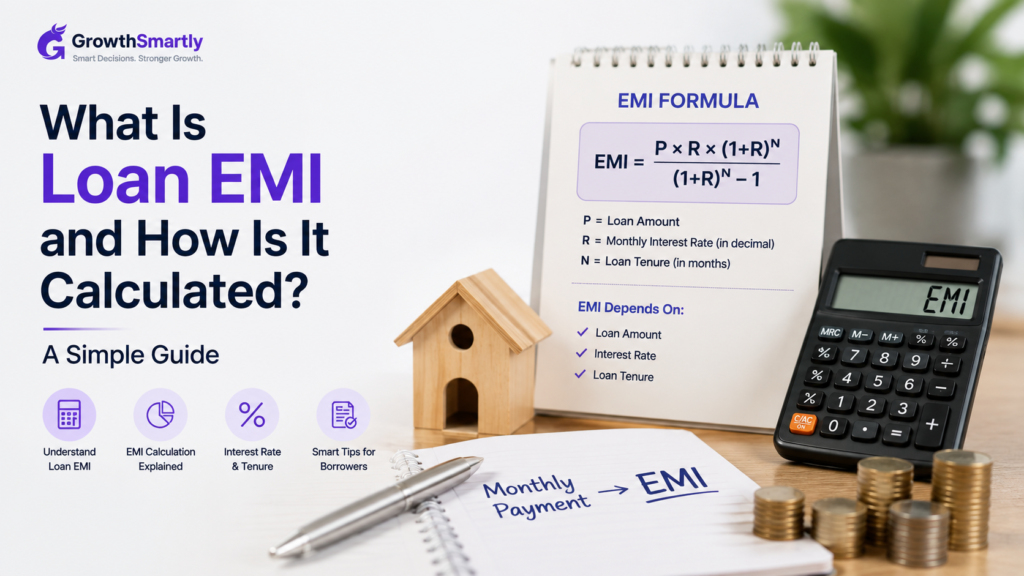
You’ve probably seen the term EMI on almost every loan advertisement, whether it’s for a phone, a car, or a house. Banks flash it everywhere: “EMI starting at ₹999.” But if you’ve ever wondered how that number is actually arrived at, or why two loans of the same amount can have very different EMIs, this guide is for you.
Understanding EMI isn’t just useful trivia. It directly affects how much you end up paying over the life of any loan, and knowing the mechanics behind it can help you negotiate better terms or choose the right tenure.
What Does EMI Actually Mean?
EMI stands for Equated Monthly Installment. It’s the fixed amount you pay to your lender every month until your loan is fully repaid. The word “equated” is the key part here — the amount stays the same every month for the entire tenure, even though what that amount is made up of changes over time.
Every EMI payment is split into two components: principal (the actual amount you borrowed) and interest (the cost of borrowing that money). What changes month to month is the ratio between the two, not the total EMI itself.
The EMI Formula
EMI is calculated using a fairly standard formula:
EMI = [P × R × (1+R)^N] / [(1+R)^N – 1]
Where:
- P = Principal loan amount
- R = Monthly interest rate (annual rate divided by 12, then divided by 100)
- N = Loan tenure in months
You don’t need to calculate this by hand. Every bank website and most finance apps offer free EMI calculators where you simply enter the loan amount, interest rate, and tenure to get your monthly figure instantly. But understanding what’s happening behind that number helps you make smarter borrowing decisions.
Why the Early Months Feel Different
Here’s something that surprises a lot of first-time borrowers: in the early years of a loan, a much larger chunk of your EMI goes toward interest, and only a small portion reduces the actual principal. As the loan progresses, this ratio gradually flips, and more of each EMI starts chipping away at the principal.
This happens because interest is calculated on the outstanding loan balance, which is highest at the start. It’s also why making prepayments early in a loan tenure has a much bigger impact on reducing your total interest cost compared to prepaying the same amount later on.
What Factors Affect Your EMI Amount?
Three things primarily determine your EMI: the loan amount, the interest rate, and the tenure. A higher loan amount naturally means a higher EMI, all else being equal. A higher interest rate increases the EMI too, since you’re paying more for the same borrowed sum.
Tenure works a little differently. A longer tenure lowers your monthly EMI, which can make a loan feel more affordable month to month, but it also means you pay significantly more in total interest over the life of the loan. A shorter tenure raises the EMI but reduces your overall interest cost. There’s a genuine trade-off here, and the right choice depends on your monthly cash flow versus your appetite to minimize total cost.
Fixed vs Floating Rate EMIs
If your loan has a fixed interest rate, your EMI stays constant for the entire tenure, which makes budgeting predictable. If it’s a floating rate loan, your EMI (or your tenure, depending on the lender’s policy) can change whenever the benchmark interest rate moves. This is common with home loans in India, so it’s worth checking with your lender how rate changes get applied to your specific loan.
How to Use EMI Calculations to Your Advantage
Before taking any loan, it helps to run the numbers across a few different tenures rather than just accepting the first EMI figure quoted to you. A slightly longer tenure might reduce monthly pressure on your budget, but check the total interest cost side by side before deciding. Many borrowers focus only on “can I afford this EMI” without checking “how much will this loan actually cost me by the end.”
If your income allows for it, even a small step-up in EMI or occasional prepayments can shave years off a long-tenure loan and save a substantial amount in interest.
The Bottom Line
EMI is simply the mechanism that turns a large loan into manageable monthly payments, but the amount, tenure, and interest rate you choose have a real impact on how much you ultimately pay. Use an EMI calculator before committing to any loan, compare tenures honestly, and remember that the lowest monthly EMI isn’t always the cheapest loan in the long run.
Frequently Asked Questions
1. What is the full form of EMI?
EMI stands for Equated Monthly Installment, which is the fixed monthly payment you make toward repaying a loan, covering both principal and interest.
2. Does the EMI amount ever change during the loan tenure?
For fixed-rate loans, the EMI stays the same throughout the tenure. For floating-rate loans, the EMI can change if the lender’s benchmark interest rate moves, though some lenders adjust the tenure instead of the EMI amount.
3. Why does interest form a bigger part of EMI in the early months?
Interest is calculated on the outstanding loan balance, which is at its highest right at the start of the loan. As you repay principal over time, the balance decreases, so the interest portion of each EMI gradually reduces too.
4. Is a longer loan tenure always a bad idea?
Not necessarily. A longer tenure lowers your monthly EMI, which can ease monthly cash flow, but it increases the total interest you pay over the life of the loan. The right choice depends on balancing monthly affordability against long-term cost.
5. Can I calculate EMI without using a calculator?
Yes, you can use the standard EMI formula manually, but it involves compounding calculations that are easy to get wrong by hand. Using an online EMI calculator is faster and far less error-prone for everyday use.